
It is true that solar thermal collectors are currently more efficient per square meter (area) than solar PV modules in collecting solar energy. However, overall efficiency must also take into consideration factors such as heat loss in piping (especially in winter) and energy use of solar thermal circulation pumps.
Solar thermal system lifetimes range from about 7 years (for cheap imports) to about 15 years for high quality (and more expensive) systems. (In a comprehensive analysis, Sandia National Laboratories found that about 50% of solar thermal systems fail within a 10-year period.) Solar PV modules are routinely guaranteed at 80% performance after 25 years, and the US National Renewable Energy Laboratory uses a lifetime of 33 years in its solar PV system calculations.
Solar PV module costs have dropped dramatically – by over 80% in the past 5 years – and the trend is continuing. This has changed the paradigm. Whilst solar PV systems will continue to require more roof space than solar thermal in the short term, the key issue is not roof space, but cost. Solar PV systems have become cost-competitive to solar thermal, and the much longer lifetimes and lower maintenance translate into a lower lifetime cost per kWh.
You can register here:
It is a set of energy efficiency regulations that are compulsory for new buildings and for additions and extensions to existing buildings. One of the key requirements of SANS 10400-XA is that no more than 50% of the annual volume of domestic hot water must be heated using grid electricity.
The PowerOptimal Elon® makes meeting this requirement easier than ever before, providing a new cost-effective alternative to heat pump and solar thermal systems.
Not necessarily. PowerOptimal Elon® works with existing standard AC heater elements, but the best element size (power rating) depends on the size of your solar PV array. If you are building a new house, you can just specify the right heater element from the start. Refer to the Easy Selection Guide on the Downloads page or ask the PowerOptimal agent or your installer about the best solar PV module & heater element matching configuration for your needs.
The most important factor here is the total size or power of the solar PV array (measured in kilowatt or kWp) rather than the number of modules. We recommend a minimum of 1 kWp.
The maximum solar power rating for the Elon 100 is 4 kWp and for the Elon Smart it is 3 kWp.
DO NOT exceed the maximum solar voltage and current ratings for the Elon 100 and Elon Smart, which are as follows:
Elon 100
Isc < 20A DC
Voc < 250V DC
Elon Smart
Isc < 15A DC
Voc < 230V DC
The size of solar PV array required depends on the number of people in the household as well as your hot water usage levels. Below is a basic guide.
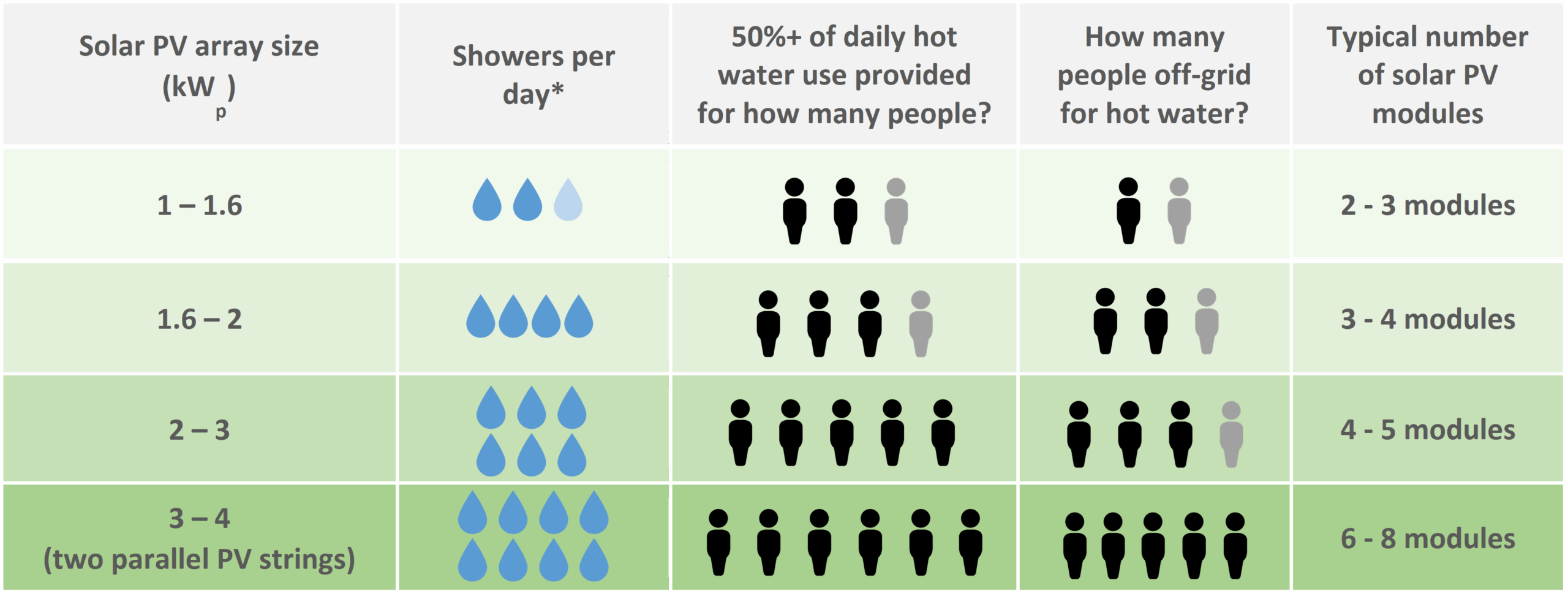
* 6-minute showers at 40 °C with 8 litre/min (low-flow) showerhead
Please note: two parallel strings are only allowed for Elon 100, and only where the short-circuit current (Isc) of the panels are less than 10A (so that the short-circuit current of the parallel string would be less than 20A).
To understand the full cost of any water heating solution, you have to consider several things: the upfront (capital) cost, the ongoing (operating) cost, the maintenance cost as well as how long the solution will last before you have to replace it (lifetime). Otherwise you cannot do a proper comparison.
The full cost of energy that considers ALL cost components well as the lifetime is called the Levelized Cost of Energy or LCOE.
When comparing South African energy options including grid electricity, solar thermal (solar geysers), heat pumps, gas and solar PV, the Elon® is the most cost-effective of all the options. See the full results and methodology here (click on the “Levelized Cost of Energy” tab).
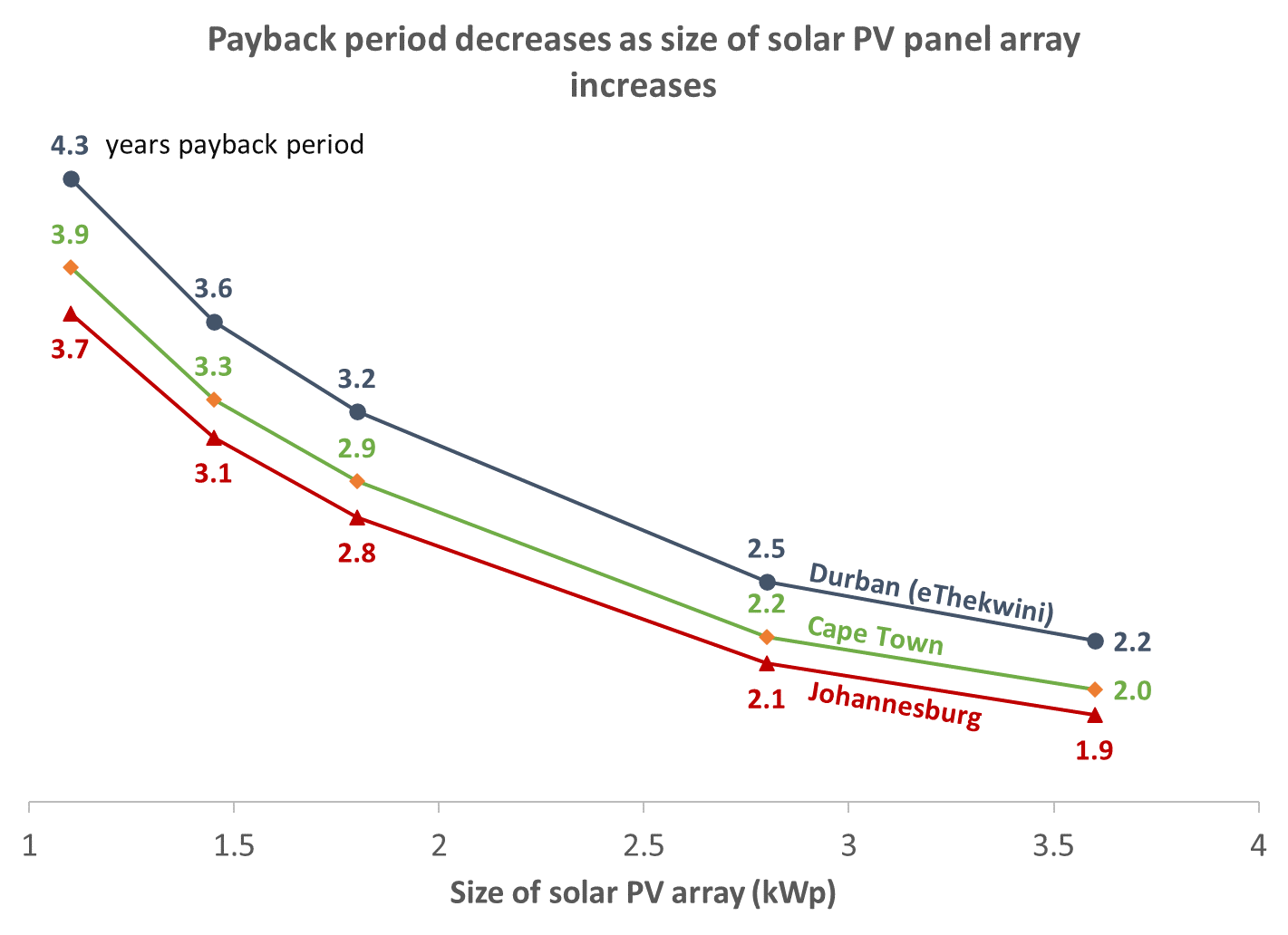
This depends on your current electricity tariff, how many solar modules you install, your hot water use, and electricity price increases in the next few years, but typically payback period is in the range of 2 to 4.5 years. With a typical solar module life expectancy of more than 30 years, this means that you will enjoy at least 25 years of free hot water!
See the Case Studies page for more performance information.
Explore the website (see for example the case studies page and the downloads menu item) or contact the PowerOptimal team for more information.
The short answer is NO.
In South Africa most houses use a TN earth. This means the utility supplied neutral (earthed at the transformer) is used as an earth for the house. In the DB board the earth bar is connected to the neutral before the earth leakage.
In cases where the supply to the house is a standalone inverter or generator, the municipal supply is required to be disconnected by a change-over switch before the alternate supply is started.
Grid tied inverters require disconnection on loss of grid to avoid back feed. When the municipal supply is disconnected, the installation’s earth is lost and these installations require a separate earth (typically an earth spike) to meet SANS 10142 safety requirements.
The Elon solar PV water heater never disconnects the supply to the house and does not interfere with the existing earthing arrangement. Therefore it does NOT need a separate earth spike.
The building code requires bonding and earthing of all large metal structures in a house. The solar panels and mounting frames are a large metal structure. This bonding does not require a separate earth spike. Bonding can use an existing earth terminal such as those found on the DB board or can bond to existing metal that is in turn bonded.
SANS 10142 allows 3 different protection mechanisms for different parts of a fixed installation (earthing and bonding with overcurrent; electrical separation of circuits with insulation failure detect; and extra low voltage). Elon provides safety on the solar side through ‘electrical separation of circuits with insulation failure detect’ and not earthing and bonding. This is because solar panels are inherently current limited and therefore cannot generate the overcurrent required to trip a circuit breaker to disconnect the installation on fault.
In summary: a TN Earth is always active even during load shedding provided the municipal supply has not been disconnected at the incomer. Since the Elon does not require disconnection of the municipal supply, it can use the supplied TN Earth and does not require an earth spike.
If the house has no municipal supply and/or is not connected to the municipal earth, then it already needs to have its own earth installed (which can then be used by the Elon).
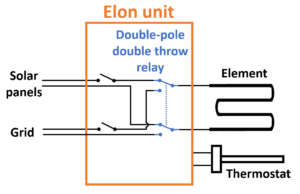
Off-grid. The Elon has a double-pole, double-throw, break-before-make changeover relay that switches power supply to the element between solar PV (DC) and grid (AC). That means that it is impossible for DC power to flow into the AC supply or for AC power to flow into the DC supply. Hence, the Elon qualifies as ‘off-grid’ for solar PV installations.
See the below diagram that shows the internals of the Elon 100:
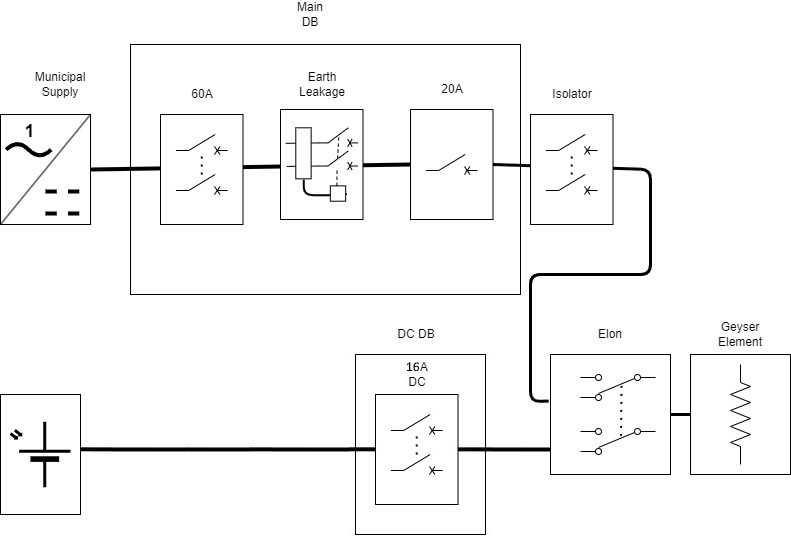
Below is an example line diagram showing how the Elon system is connected into the wiring of the premises:
Loadshedding
Both the Elon 100 and Elon Smart will continue functioning during loadshedding as long as the sun is shining. If there is loadshedding at night or when there is no sun, then the Elon 100 or Elon Smart will be off.
Power surges
The Elon 100 has AC overvoltage protection and can withstand AC voltages of up to 500V (more than double the normal 230V AC voltage) indefinitely. At voltages above 270V, it will disconnect the element to protect it. Once the voltage returns to the ‘normal’ range, it will reconnect the element.
The Elon Smart also has extensive surge protection built in.
However, for high lightning strike areas, installation of a surge protection device (SPD) is recommended.
No, the Elon Smart is designed to fit into Kwikot geysers. It should NOT be installed in geysers from other manufacturers.
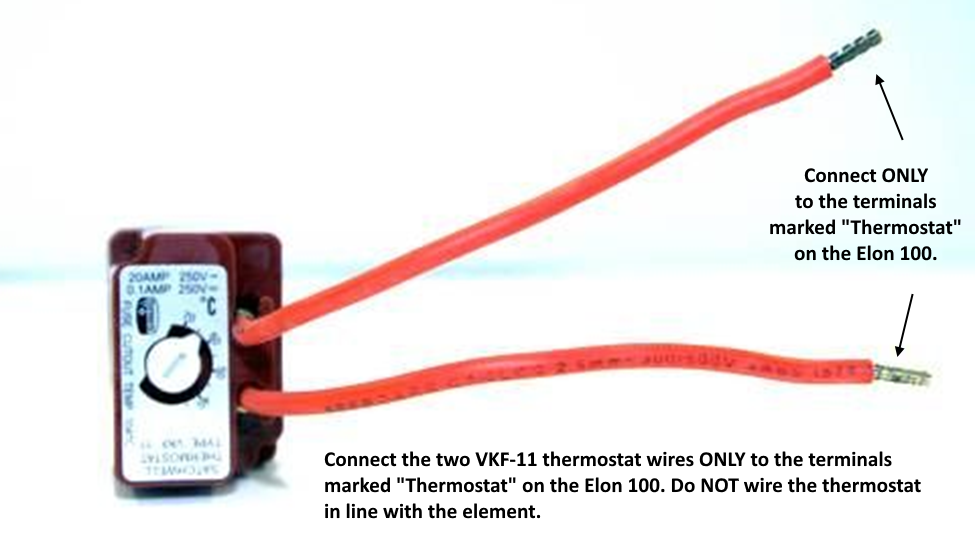
Yes – the Elon 100 works with any standard electric geyser with TSE or VKF-11 thermostats. Please read Section 5 of the installation manual for how to wire the VKF-11 thermostat when installing an Elon unit.
No, neither the Elon 100 nor the Elon Smart have a MPPT.
Maximum Power Point Tracking (MPPT) is a technique used with variable power sources like solar PV modules to maximise energy extraction as the power output varies.
Most inverters and charge controllers have MPPT built in.
However, MPPT adds cost, and is not strictly necessary where direct DC energy is utilised.
If the solar PV string and geyser element are matched well, the energy loss for a system with no MPPT vs a system with MPPT is small.
In fact, for Elon units, the loss is less than 10% when the PV string and element are matched well. This is because both the Elon 100 and Elon Smart start feeding energy to the geyser at just 20V under load, whilst most MPPT systems require 100 – 150V to become operational.
Hence, in low light and cloudy conditions, the Elon feeds energy to the geyser at times when an inverter or MPPT would not switch on at all. This makes up at least partially for the loss in efficiency due to the lack of a MPPT.
It’s more cost-effective to add a solar PV module than to add a MPPT.
No, Elon units should never be installed in series with a MPPT. This is because the Elon utilises the current-limiting characteristic of solar PV modules for switching. If a MPTT is installed in between the Elon unit and the solar PV modules, it might get damaged or interfere with the switching.
Please note: ALL Elon 100 installations as well as all Elon Smart installations that include solar PV have to be commissioned by a registered electrician and a Supplementary CoC (Certificate of Compliance) issued. When the Elon Smart thermostat is installed on its own (without solar PV), a Supplementary CoC is NOT required.
We strongly recommend the use of a PV-Greencard registered installer to install your Elon solar PV water heater system. Don’t do it yourself! Electricity is dangerous and you can endanger yourself and your family.
Installers can contact PowerOptimal for information on in-person training sessions on doing Elon installations. See also the basic online training courses on Elon installations here.
No, at this time the Elon Smart is NOT compatible with Xtend PTC elements.
Please check with a knowledgeable installer in your local municipality, or check the local municipality website. For most municipalities, approval is not required, only registration of your solar PV installation.
For City of Cape Town, approval is required, but no sign-off by a registered professional electrical engineer is required (unlike for other types of solar PV installations).
Further information on City of Cape Town approval for installers
The City of Cape Town mandates online authorization for installers of solar PV systems, including solar PV water heaters, through its e-Services platform. For solar PV water heaters, the application includes a specific tick box (section 4), exempting the need for electrical engineer sign-off on the wiring. Installers must confirm adherence to wiring diagram 5.2. Unregistered installations may incur penalties, so it is important to comply.
So what does this mean for Elon installers?
1. You need to register your company on the City of Cape Town e-Services platform if you have not done so already;
2. Submit the City of Cape Town’s online SSEG application form for each Elon 100 installation or project, making sure to tick the “Solar PV geyser SSEG” option, and the “Sheet 5.2” single line diagram option.
See the City of Cape Town’s SSEG page for more information.
Yes, you can connect your inverter AC output to the Elon Smart AC (grid) input.
However, you should remember that, when the element is drawing power from the AC side via the Elon Smart, it will draw the full power rating of the element. For example, if it is a 3 kW element, it will draw 3 kW of power. If it is a 4 kW element, it will draw 4 kW of power.
Thus, you will need at least an 8 kW inverter to avoid frequent inverter tripping. Even for an 8 kW inverter, you cannot switch on many high-powered appliances at the same time as the geyser.
You should also keep in mind that a 3 or 4 kW power draw can drain your batteries quickly. Hence, you only want to use inverter geyser heating in the early to mid-afternoon, when batteries are typically fully charged and the solar PV output is high.
The recommended time zone for custom AC heating timer settings on the Elon Smart is in the 12:30 – 15:00 window. You can experiment with the length of this ‘boost’ window to suit your specific circumstances and solar PV installation (for example, you can set it to run on AC / grid power from 13:30 – 15:00).
An alternative is to manually press the ‘heat with grid now’ button in the Elon Smart app on days when the batteries are full. But this requires manual monitoring, which is not always desirable.
Please note: Do NOT install a timer between the inverter and the Elon Smart. The inverter should be set up to always supply power to the Elon Smart. Use the Elon Smart’s custom timers to control when the geyser is heated from the inverter.
The Elon 100 determines the time using the solar PV modules, since they are excellent solar sensors. Specifically, it determines the time through the sun’s zenith (or highest point reached by the sun around mid-day – also called the solar noon). The time when the sun reaches it’s zenith does not vary a lot over the 4 seasons at any location in South Africa (about 20 minutes max), so this is a good way to determine the time without requiring internet connectivity. On first start-up after installation, the Elon calibrates its time using the sun over the first 4 – 5 days. It continues to make small adjustments across the seasons to track the actual solar noon time at that location.
Yes – the Elon 100 works with any standard electric geyser with TSE or VKF-11 thermostats. Please note: Do NOT connect the VKF-11 thermostat in line with the element. Connect the two thermostat wires only to the two terminals marked “thermostat” on the Elon 100 unit. Connect the element separately to the two terminals marked “element” on the Elon 100 unit. Then insert the VKF-11 thermostat into the thermostat pocket in the element as normal.
kWh is a unit of energy. It is equivalent to 1 kilowatt (kW) of power expended for 1 hour.
If you have a light bulb of 100W, then it will consume 1 kWh in 10 hours (0.1 kW x 10h = 1 kWh).
If you have a geyser with a 3 kW element, then it will consume 3 kWh every hour when using grid power.